Design an 'IIR' filter
Usage
design_filter_iir(
  method = c("butter", "cheby1", "cheby2", "ellip"),
  sample_rate,
  filter_order = NA,
  use_sos = TRUE,
  high_pass_freq = NA,
  high_pass_trans_freq = NA,
  low_pass_freq = NA,
  low_pass_trans_freq = NA,
  passband_ripple = 0.1,
  stopband_attenuation = 40
)
Arguments
- method
filter method name, choices are
"butter","cheby1","cheby2", and"ellip"- sample_rate
sampling frequency
- filter_order
suggested filter order. When
use_sos=TRUE(default) this order is used as-is since 'SOS' form is numerically stable at any order. Whenuse_sos=FALSEand 'ARMA' form becomes numerically unstable, the order will be automatically reduced with a warning; leaveNA(default) to let the function choose automatically.- use_sos
logical; when
TRUE(default), the filter is also stored as aSos(second-order sections) object infilter$sos, and no stability-based order correction is performed. WhenFALSE, the order is capped at the maximum stable 'ARMA' order (with a warning if a specificfilter_orderwas requested).- high_pass_freq
high-pass frequency; default is
NA(no high-pass filter will be applied)- high_pass_trans_freq
high-pass frequency band-width; default is automatically inferred from filter type.
- low_pass_freq
low-pass frequency; default is
NA(no low-pass filter will be applied)- low_pass_trans_freq
low-pass frequency band-width; default is automatically inferred from filter type.
- passband_ripple
allowable pass-band ripple in decibel; default is
0.1- stopband_attenuation
minimum stop-band attenuation (in decibel) at transition frequency; default is
40dB.
Value
A filter object with $b/$a 'ARMA' coefficients and
$sos second-order sections (a gsignal Sos object).
Examples
sample_rate <- 500
my_diagnose <- function(
filter, vlines = c(8, 12), cutoffs = c(-3, -6)) {
diagnose_filter(
b = filter$b,
a = filter$a,
fs = sample_rate,
vlines = vlines,
cutoffs = cutoffs
)
}
# ---- Default using butterworth to generate 8-12 bandpass filter ----
# Butterworth filter with cut-off frequency
# 7 ~ 13 (default transition bandwidth is 1Hz) at -3 dB
filter <- design_filter_iir(
method = "butter",
low_pass_freq = 12,
high_pass_freq = 8,
sample_rate = 500
)
filter
#> <IIR filter>
#> Type : pass
#> Method: butter
#> Order: 9
#> Magnitude:
#> Freq=8 Hz, mag=-175.2 dB (expected=-0.1 dB)
#> Freq=12 Hz, mag=-146.5 dB (expected=-0.1 dB)
#> Freq=6 Hz, mag=-198.9 dB (expected=-40 dB)
#> Freq=15 Hz, mag=-124.6 dB (expected=-40 dB)
#> Reciprocal condition number: 1.4e-22 < .Machine$double.eps
#>
#> WARNING:
#> * Unstable autoregressive (AR) polynomial coefficients
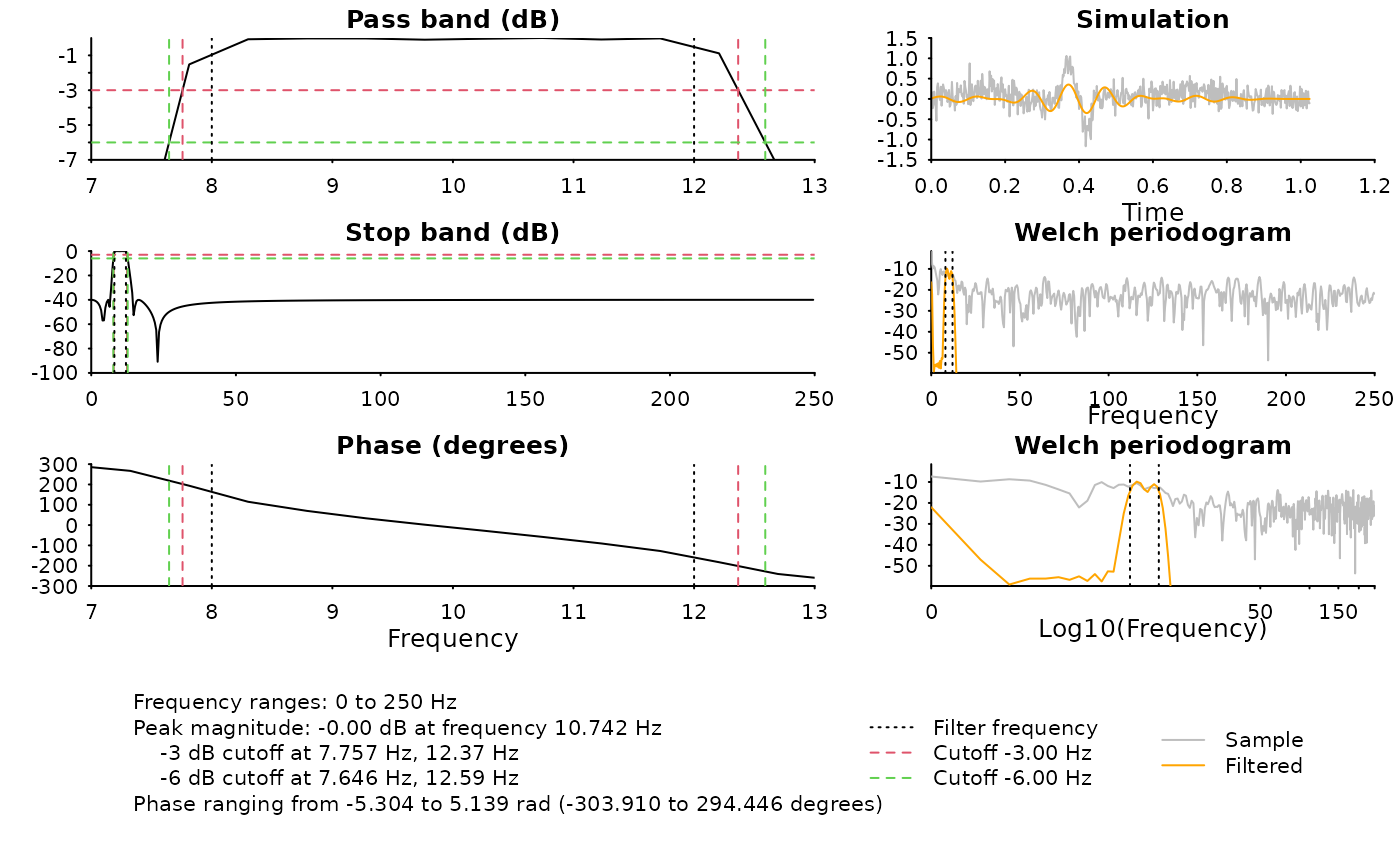
my_diagnose(filter)
 ## explicit bandwidths and attenuation (sharper transition)
# Butterworth filter with cut-off frequency
# passband ripple is 0.5 dB (8-12 Hz)
# stopband attenuation is 40 dB (5-18 Hz)
filter <- design_filter_iir(
method = "butter",
low_pass_freq = 12, low_pass_trans_freq = 6,
high_pass_freq = 8, high_pass_trans_freq = 3,
sample_rate = 500,
passband_ripple = 0.5,
stopband_attenuation = 40
)
filter
#> <IIR filter>
#> Type : pass
#> Method: butter
#> Order: 5
#> Magnitude:
#> Freq=8 Hz, mag=-0.5076 dB (expected=-0.5 dB)
#> Freq=12 Hz, mag=-0.5011 dB (expected=-0.5 dB)
#> Freq=5 Hz, mag=-45.85 dB (expected=-40 dB)
#> Freq=18 Hz, mag=-41.04 dB (expected=-40 dB)
#> Reciprocal condition number: 1.7e-15 > .Machine$double.eps
my_diagnose(filter)
## explicit bandwidths and attenuation (sharper transition)
# Butterworth filter with cut-off frequency
# passband ripple is 0.5 dB (8-12 Hz)
# stopband attenuation is 40 dB (5-18 Hz)
filter <- design_filter_iir(
method = "butter",
low_pass_freq = 12, low_pass_trans_freq = 6,
high_pass_freq = 8, high_pass_trans_freq = 3,
sample_rate = 500,
passband_ripple = 0.5,
stopband_attenuation = 40
)
filter
#> <IIR filter>
#> Type : pass
#> Method: butter
#> Order: 5
#> Magnitude:
#> Freq=8 Hz, mag=-0.5076 dB (expected=-0.5 dB)
#> Freq=12 Hz, mag=-0.5011 dB (expected=-0.5 dB)
#> Freq=5 Hz, mag=-45.85 dB (expected=-40 dB)
#> Freq=18 Hz, mag=-41.04 dB (expected=-40 dB)
#> Reciprocal condition number: 1.7e-15 > .Machine$double.eps
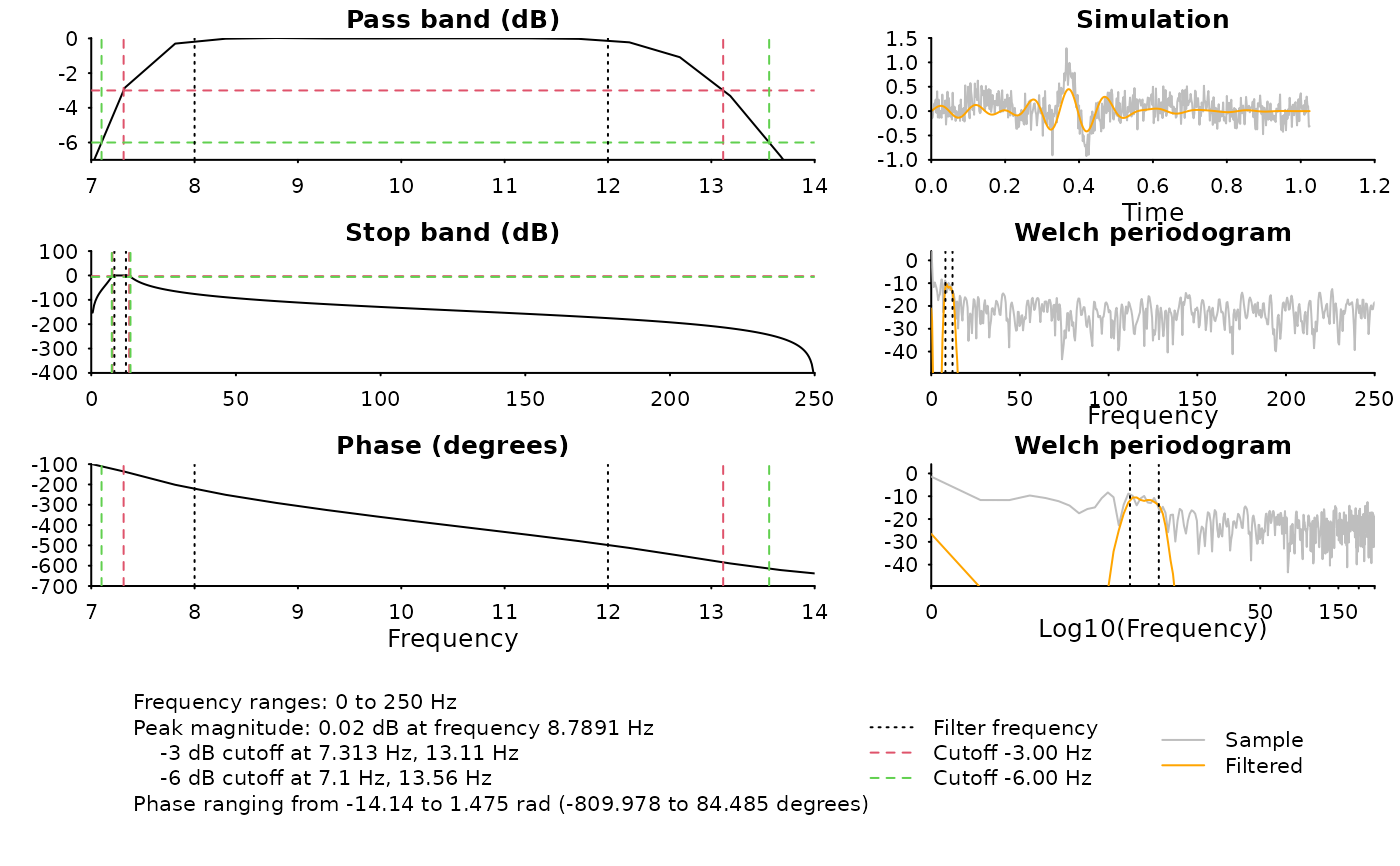
my_diagnose(filter)
 # ---- cheby1 --------------------------------
filter <- design_filter_iir(
method = "cheby1",
low_pass_freq = 12,
high_pass_freq = 8,
sample_rate = 500
)
my_diagnose(filter)
# ---- cheby1 --------------------------------
filter <- design_filter_iir(
method = "cheby1",
low_pass_freq = 12,
high_pass_freq = 8,
sample_rate = 500
)
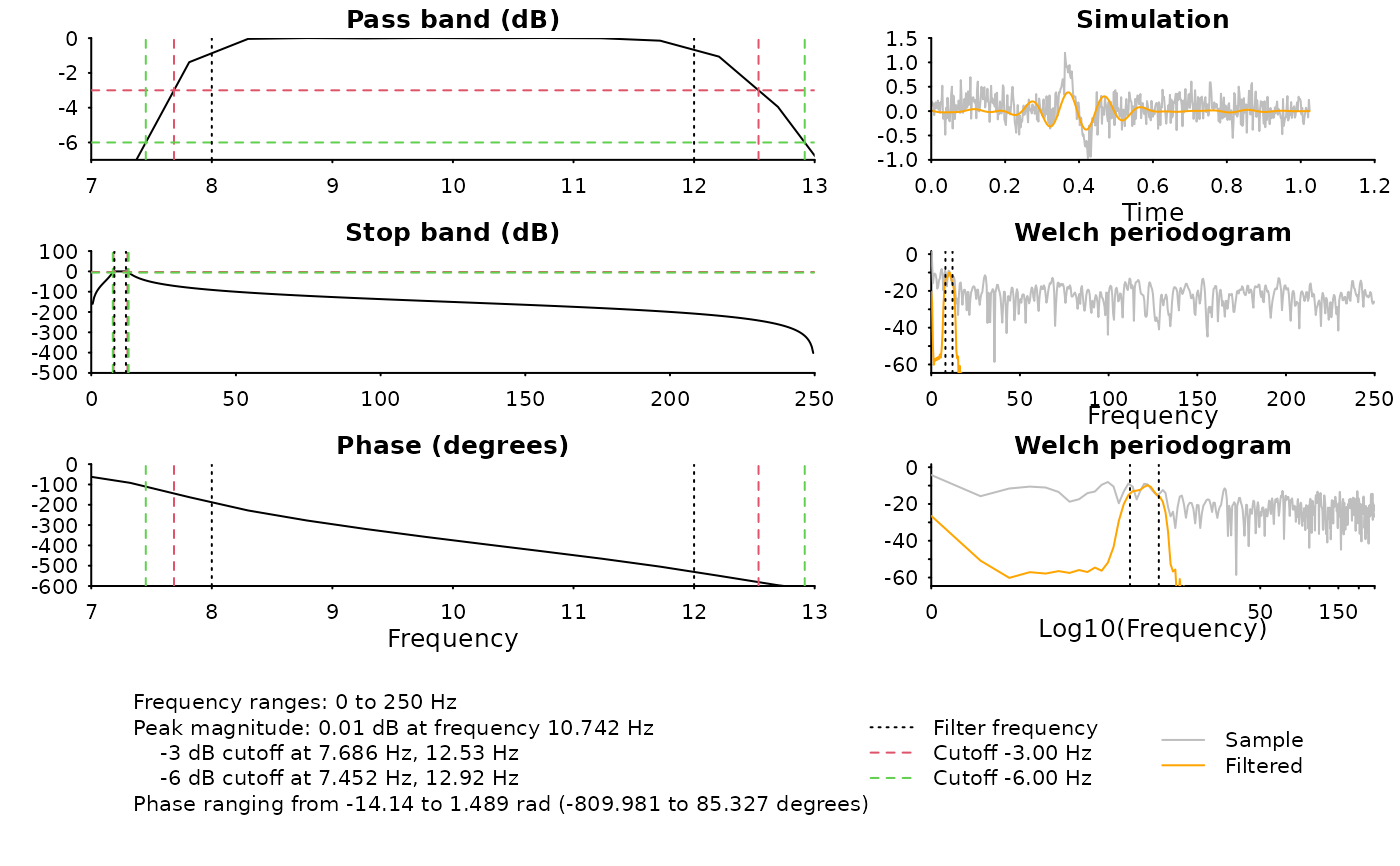
my_diagnose(filter)
 # ---- cheby2 --------------------------------
filter <- design_filter_iir(
method = "cheby2",
low_pass_freq = 12,
high_pass_freq = 8,
sample_rate = 500
)
my_diagnose(filter)
# ---- cheby2 --------------------------------
filter <- design_filter_iir(
method = "cheby2",
low_pass_freq = 12,
high_pass_freq = 8,
sample_rate = 500
)
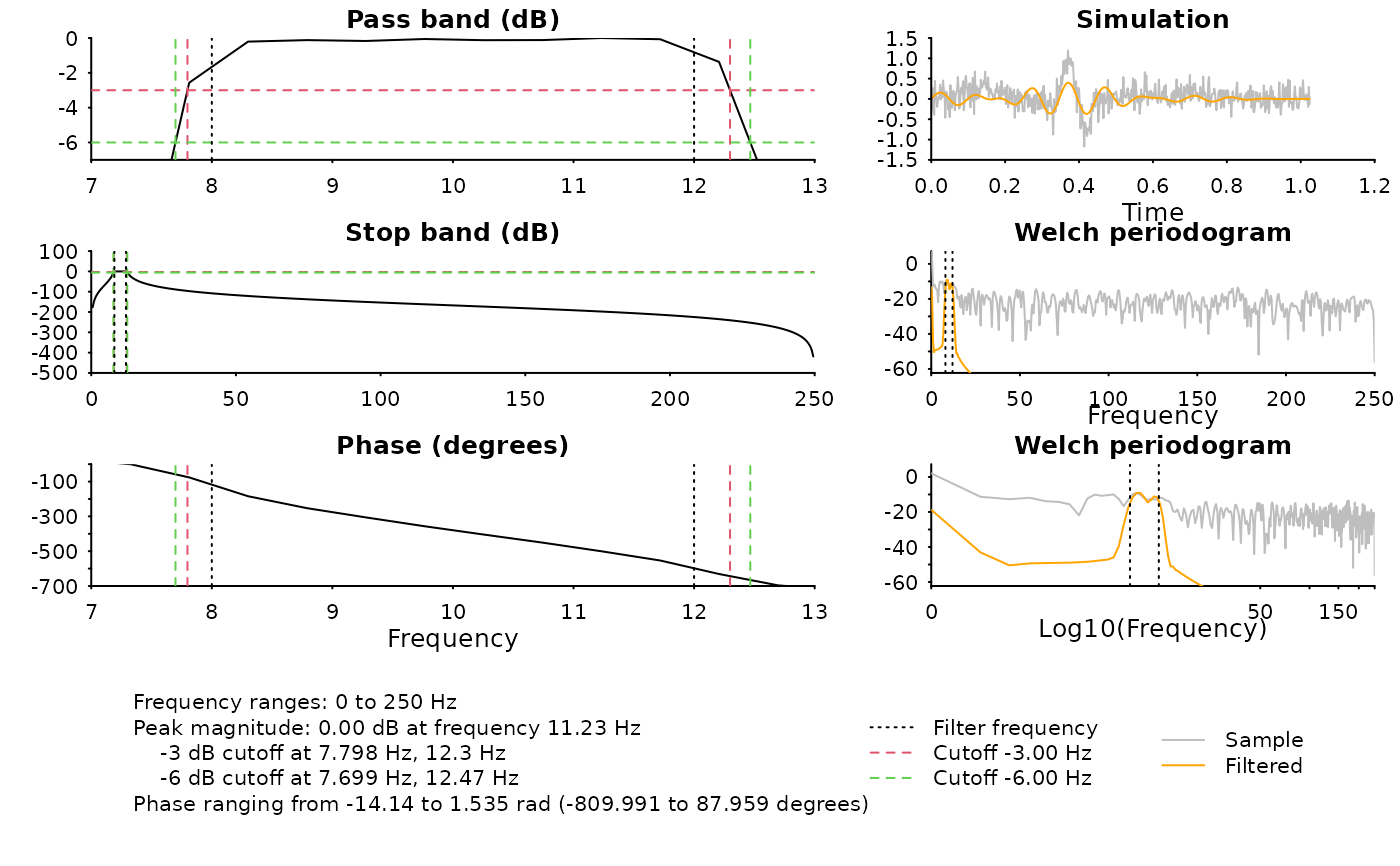
my_diagnose(filter)
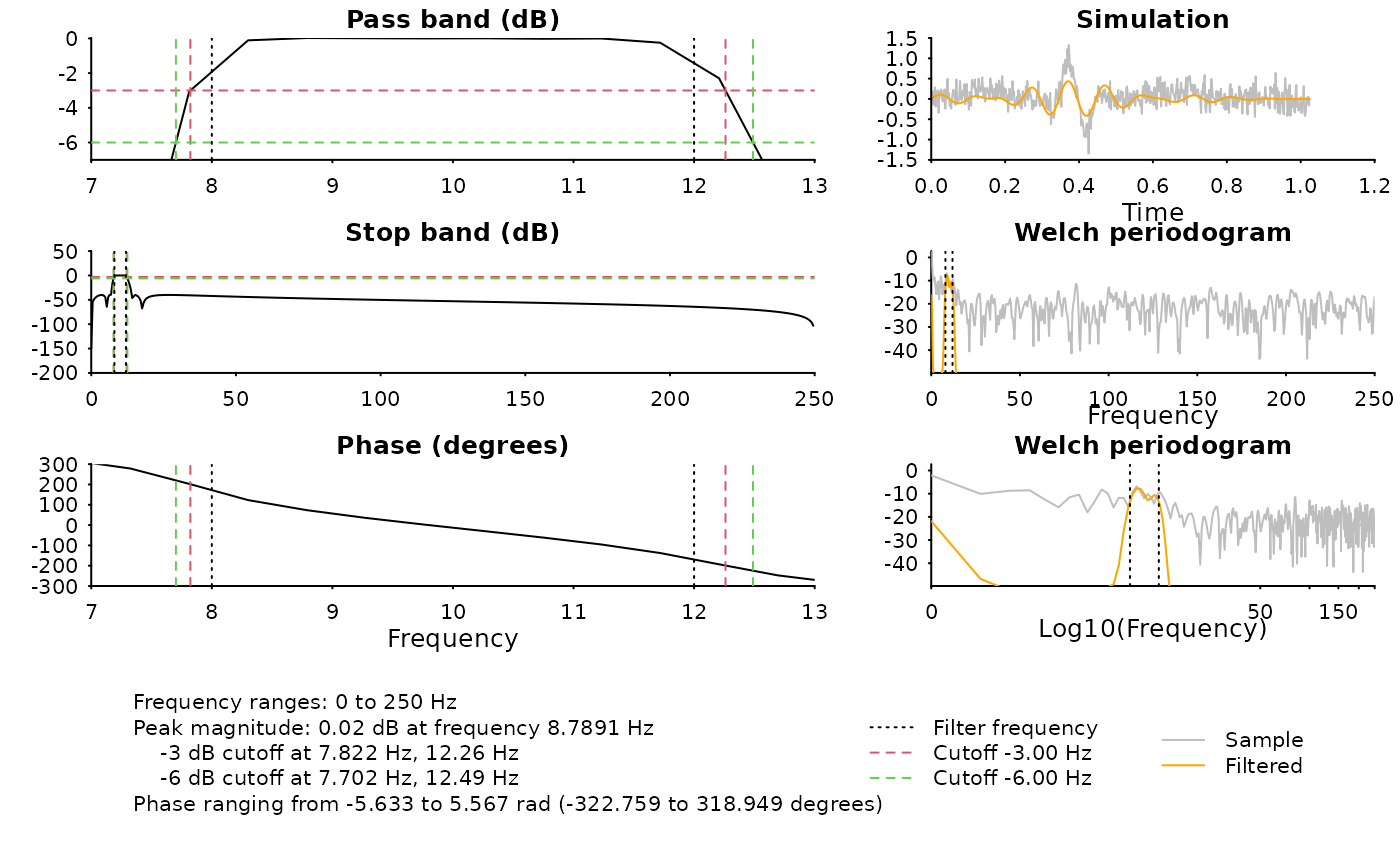 # ----- ellip ---------------------------------
filter <- design_filter_iir(
method = "ellip",
low_pass_freq = 12,
high_pass_freq = 8,
sample_rate = 500
)
my_diagnose(filter)
# ----- ellip ---------------------------------
filter <- design_filter_iir(
method = "ellip",
low_pass_freq = 12,
high_pass_freq = 8,
sample_rate = 500
)
my_diagnose(filter)